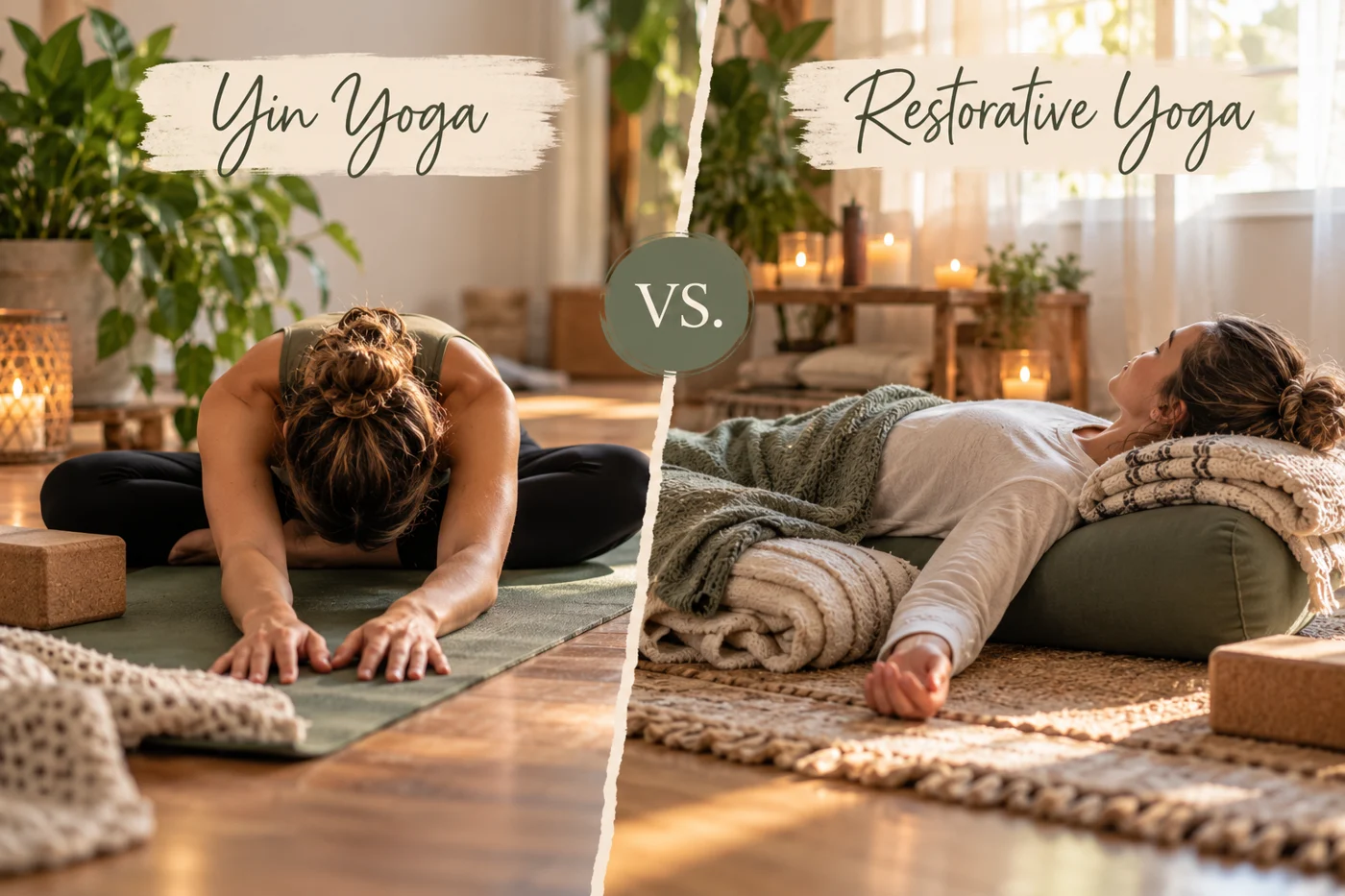
If you have ever looked for a slower style of yoga, there is a good chance you have come across both yin yoga and restorative yoga. At first glance, they can look almost identical. The room is quiet, the movements are slow, poses may be held for several minutes, and nobody appears to be rushing through a workout.
But yin and restorative yoga are not actually the same practice.
Both can offer a slower alternative to more active styles of yoga, but they use that stillness differently. Yin generally involves settling into sustained positions where you may feel a noticeable stretch or moderate sensation. Restorative yoga usually uses blankets, bolsters, blocks, and other props to support the body so thoroughly that very little physical effort is required.
Neither style has to be “better.” They simply offer different experiences, and understanding that difference can make it much easier to choose what your body needs on a particular day.
First, Yoga Is Much Bigger Than Exercise
Modern yoga classes often emphasize physical postures, but yoga has much deeper roots than what we typically see in a fitness studio. Yoga originated within Indian philosophical and spiritual traditions and historically included ethical practices, meditation, breathing practices, and other elements in addition to physical postures.
In the United States today, yoga classes often focus primarily on a combination of postures, breathing, and meditation. The National Center for Complementary and Integrative Health notes that styles of yoga can range from very gentle to physically demanding, which is one reason research simply labeled “yoga” can be difficult to interpret. Different studies may be investigating very different practices under the same broad name. NCCIH
That same distinction matters when we compare yin and restorative yoga. Both fall under the yoga umbrella, but the experience inside the pose can be quite different.
What Is Yin Yoga?
Yin yoga is a slow practice in which many poses are held for several minutes, often while sitting or lying on the floor. Rather than continuously moving from one posture into another, the practitioner settles into a position, becomes relatively still, and spends time noticing the sensations that arise.
Yin classes often include positions that create a sustained stretch around areas such as the hips, thighs, pelvis, and spine. Props may absolutely be used, but the goal is not necessarily to eliminate sensation. A yin pose may feel moderately challenging even though you are not actively contracting the muscles in the same way you might during a strength-based yoga practice.
This makes yin a little deceptive. It looks extremely easy when you watch someone lying quietly on a mat, but spending several minutes in one position can feel surprisingly intense.
One of the skills within a thoughtful yin practice is learning the difference between sensation and pain. You do not need to force yourself as deeply as possible into a position simply because the class is slow.
What Is Restorative Yoga?
Restorative yoga takes a different approach to stillness.
Rather than intentionally settling into a sustained stretch, restorative poses are generally arranged so that the body is fully supported. Bolsters, blankets, blocks, straps, chairs, walls, or other props may be used to remove muscular effort and allow someone to stay comfortably in a position for an extended period.
A restorative pose may last several minutes or longer, but the goal is usually not to increase the stretch as time passes. In fact, if you are fighting to stay in position or feeling a strong physical pull, you may need another blanket or bolster.
Think of it this way: in yin, you may be quietly working with sensation. In restorative yoga, you are often trying to create enough support that you can stop working so hard altogether.
That small difference changes the entire experience.
Yin Is Not Just “Restorative Yoga Without Props”
This is probably the easiest misunderstanding to make.
Both styles can be slow. Both may use props. Both often involve longer holds. Both may incorporate breathing and mindfulness. But the intention behind the support is different.
In yin yoga, a block or bolster might help you find an appropriate amount of sensation while remaining still. In restorative yoga, props are typically arranged specifically to take strain away from the body so that you can remain comfortable without holding yourself up.
That means somebody who thinks they are signing up for “really relaxing yoga” may be surprised the first time they attend a yin class and spend several minutes in a deep hip position.
And someone expecting to stretch may be equally surprised by restorative yoga when the instructor keeps adding blankets until almost nothing feels like work anymore. 😂
What Does Research Say About Yin Yoga?
Compared with yoga as a whole, yin-specific research is still fairly small. That is important because we cannot simply take every positive yoga study and assume yin yoga itself produced the same result.
There are, however, some interesting early studies.
One randomized controlled trial included 105 adults who described themselves as moderately to highly stressed. Participants were assigned to five weeks of yin yoga, yin yoga combined with psychoeducation and mindfulness, or a control group. Both yoga groups showed improvements in anxiety and sleep problems compared with controls, while the combined program also improved perceived stress and depression scores. PubMed Central (PMC)
A smaller 2024 study of 48 women found that a ten-week online yin yoga program was associated with reductions in state anxiety, meaning anxiety experienced in the moment, although it did not show the same effect on more stable trait anxiety. PubMed Central (PMC)
Those findings are interesting, but they do not establish yin yoga as a treatment for anxiety disorders, insomnia, or other medical conditions. The research base is still relatively limited, sample sizes are often small, and some interventions combine yin yoga with mindfulness or psychological education, which makes it difficult to know how much of the result came from any single component.
That is where I think we can be interested without overpromising.
What About Restorative Yoga?
Restorative yoga also has a smaller research base than yoga overall.
One longer randomized study compared restorative yoga with a low-impact stretching program in adults with metabolic syndrome. Researchers examined stress-related psychological measures and patterns of cortisol across the day. The study found some differences between the groups, but the findings were not a simple case of restorative yoga improving every outcome more than stretching. PubMed
That is actually useful to remember.
Sometimes a gentle practice helps because it provides movement, focused attention, breathing, social interaction, quiet time, or simply a scheduled opportunity to stop.
When studies compare one gentle practice against another, the differences may not be dramatic because both groups are doing something potentially supportive.
The broader research on yoga is much larger than the restorative-specific literature. NCCIH reports that yoga research overall suggests possible benefits for stress management, mental and emotional well-being, sleep, balance, and several types of pain, although results vary by population and style. NCCIH
What About the Nervous System?
This is where wellness language can get a little loose.
You will often hear that yin or restorative yoga “activates the parasympathetic nervous system,” “regulates the nervous system,” or moves someone out of “fight-or-flight.”
There is a real physiological basis for studying how slow breathing, relaxation, body position, meditation, and gentle movement interact with autonomic function. But statements such as “this pose switches your nervous system into parasympathetic mode” simplify something that is much more complex.
Our autonomic nervous system is continuously regulating things such as heart rate, digestion, blood pressure, breathing, and many other processes. It is not simply a two-position switch that flips between stressed and relaxed.
A quieter yoga practice may help some people feel calmer, slow their breathing, reduce perceived stress, or create conditions that feel restorative. That is a perfectly worthwhile outcome without needing to claim that one pose completely “resets” the nervous system.
Yin May Feel More Challenging Than It Looks
One reason I think people should know the distinction between these practices is because yin involves longer periods in positions that may load or stretch tissues around joints.
Longer does not automatically mean deeper is better.
If you have significant joint instability, an acute injury, recent surgery, osteoporosis, certain spinal conditions, or another condition affecting movement, some positions may need to be modified or avoided. Pregnancy also changes joint mechanics and may require modifications.
NCCIH considers yoga generally safe for healthy people when practiced appropriately, but injuries can occur, with sprains and strains among the more common problems. It recommends qualified instruction and appropriate modifications for older adults, pregnant people, and those with certain medical conditions or injuries. NCCIH
A good yin instructor should not be telling you to push through sharp pain because your connective tissue “needs” it.
Pain is information.
Restorative Does Not Mean You Have to Fall Asleep
Restorative yoga can sometimes feel almost suspiciously simple. 😂
You may spend ten minutes supported over a bolster while the instructor asks you to breathe and do essentially nothing else. If you are accustomed to measuring a successful wellness practice by how hard you worked, that can feel uncomfortable at first.
But rest does not need to look productive to count.
Some people find restorative yoga deeply relaxing. Others initially discover that being still gives their brain plenty of time to think about the grocery list, tomorrow's schedule, something awkward they said six years ago, and every unfinished chore in the house.
That does not mean they are doing it wrong.
Being still is a skill too.
Which One Is Better for Flexibility?
If increasing comfortable range of motion is part of your goal, yin may feel more directly connected to that experience because many of its positions involve sustained stretching.
That does not mean you should use yin as a contest to see how far you can push a joint.
Flexibility varies naturally between people, and more range of motion is not automatically healthier. Someone who is already very mobile may actually benefit from strength and stability more than additional flexibility.
Restorative yoga can include gentle stretches depending on the position, but increasing flexibility is generally not the central purpose. The props intentionally reduce the amount of muscular effort and often reduce the intensity of stretching as well.
So if your goal is primarily quiet, comfortable rest, restorative may fit better. If you enjoy long-held stretches combined with mindfulness, yin may be the better match.
You Can Use Both
This is probably my favorite part of the comparison.
You do not have to pick a yoga identity. 😂
There may be days when a slow yin practice feels wonderful because you want some movement and stretching without doing a vigorous workout. There may be evenings when even that sounds like too much and lying fully supported over a bolster sounds significantly better.
You can also encounter classes that borrow from both styles.
The name on the schedule matters less than understanding what your body is actually being asked to do.
Yoga Does Not Have to Be a Workout
One reason I wanted to start including different forms of yoga in The Iris Oracle is because movement does not always have to mean exercise harder.
Sometimes movement is walking.
Sometimes it is strength training.
Sometimes it is stretching.
Sometimes it is slowly moving through a yoga practice.
And sometimes the most supportive thing you can do is arrange three blankets, lie down, and stop asking your body to accomplish something for twenty minutes.
There is room for all of it.
That is part of what makes foundational wellness flexible enough to fit real life rather than becoming another rigid program.
What If Being Still Does Not Feel Relaxing?
This deserves mentioning, especially as we begin exploring more mind-body and trauma-informed wellness topics.
Quiet practices do not feel peaceful to everyone.
For some people, closing their eyes, focusing inward, lying still, or paying close attention to their breathing can actually feel uncomfortable or increase anxiety. NCCIH notes that while relaxation and mind-body practices generally have good safety records, some people report experiences such as increased anxiety, intrusive thoughts, or discomfort during relaxation practices. NCCIH
You do not have to force relaxation.
You might keep your eyes open.
Choose a position where you feel more alert.
Practice in a room with other people.
Take a walk instead.
Shorten the practice.
Or simply decide that this particular approach is not supportive for you right now.
Wellness should provide choices, not another place where you are told to ignore what your body is saying.
So Which One Should You Try?
If you want a very simple distinction, I would think about it this way.
Yin yoga may appeal to you if you enjoy slow movement, longer stretches, quiet reflection, and sitting with moderate physical sensation.
Restorative yoga may appeal to you if you want the physical demand turned way down and prefer supported positions designed primarily around comfort and rest.
If you are completely new to yoga, you do not need to know which category you belong in before trying either one. A beginner-friendly class with a qualified instructor can teach you far more about your preferences than reading twenty descriptions online.
And whatever you choose, there is no prize for being the person who stretches the deepest or stays the stillest.
Observe
The next time you think about movement, notice what you automatically assume it should feel like.
Does it have to make you sweat before you consider it worthwhile? Does a stretch only count if it is intense? Does lying still feel like you are wasting time?
Then notice what your body actually seems to want.
Maybe today you want movement with a little sensation and a yin practice sounds perfect. Maybe your week has already demanded enough from you and restorative yoga sounds far more appealing.
One is not the hardworking version and the other the lazy version.
They are simply different tools.
Sometimes wellness asks us to move. Sometimes it asks us to be supported enough that we can finally stop.
A Note About Yoga
Yoga is generally considered safe for many healthy people when practiced appropriately, but poses may need to be modified for pregnancy, injuries, joint or spinal conditions, osteoporosis, balance concerns, glaucoma, severe high blood pressure, and other individual circumstances. Work with an appropriately qualified instructor and healthcare professional when you are unsure whether a practice or position is suitable for you. NCCIH
References
National Center for Complementary and Integrative Health. Yoga: Effectiveness and Safety. Provides an overview of yoga research, wellness outcomes, different styles, and safety considerations. NCCIH
Daukantaitė D, et al. Five-week yin yoga-based interventions decreased plasma adrenomedullin and increased psychological health in stressed adults: A randomized controlled trial. PLOS ONE. 2018. The study included 105 moderately to highly stressed adults and evaluated yin yoga alone and yin yoga combined with mindfulness and psychoeducation. PubMed Central (PMC)
Somere M, et al. The effect of yin yoga intervention on state and trait anxiety during the COVID-19 pandemic. 2024. A study of 48 women found reductions in state anxiety following a ten-week online yin yoga intervention. PubMed
Corey SM, et al. Effect of restorative yoga vs. stretching on diurnal cortisol dynamics and psychosocial outcomes in individuals with the metabolic syndrome: the PRYSMS randomized controlled trial. Compared a restorative yoga program with low-impact stretching. PubMed
National Center for Complementary and Integrative Health. Stress. Includes safety information for relaxation, meditation, and other mind-body practices, including the possibility that inward-focused relaxation practices may feel uncomfortable for some individuals