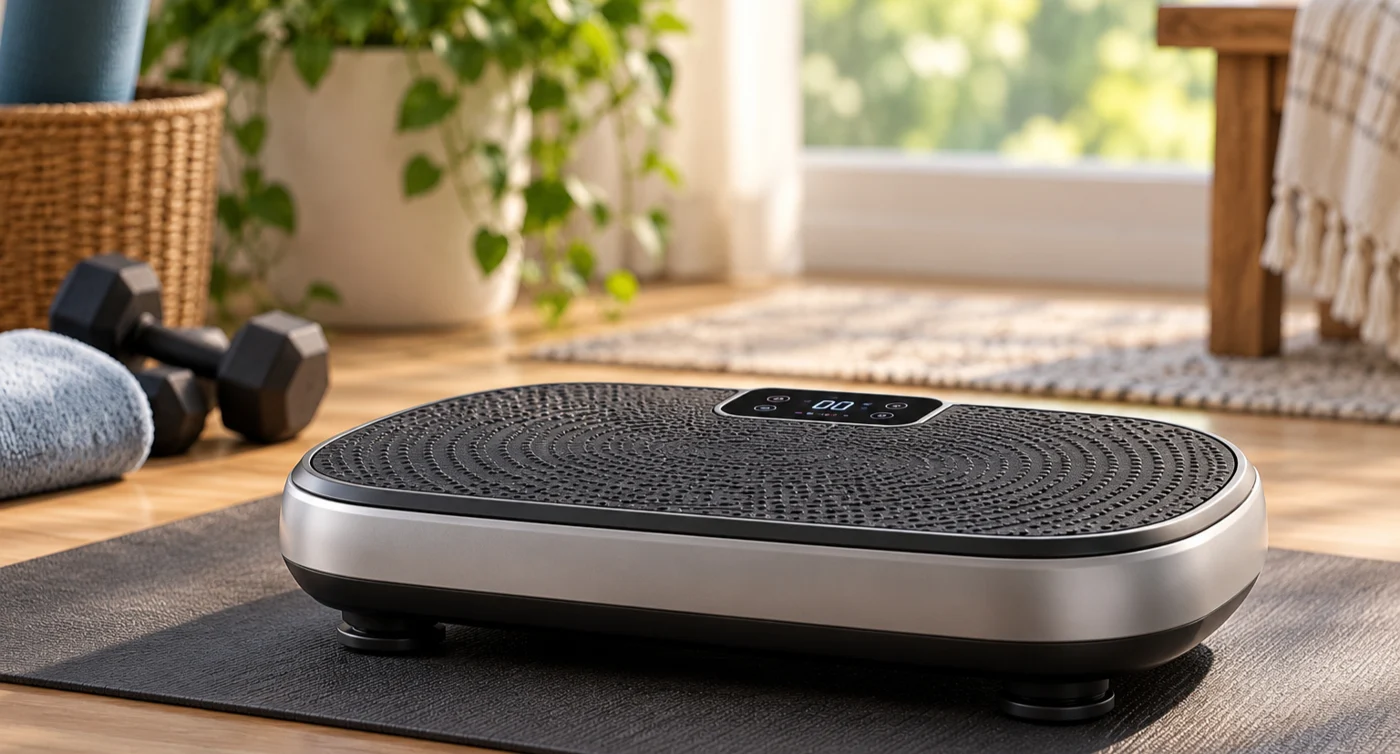
Vibration plates are one of those wellness tools that can look a little ridiculous until you start digging into the research.
You stand on a platform. The platform vibrates. Your whole body shakes. And somehow this has turned into claims about stronger muscles, better balance, improved circulation, stronger bones, lymphatic drainage, weight loss, cellulite reduction, and even “detox.”
That is quite a lot to ask from a machine whose main job appears to be making your cheeks jiggle.
But whole-body vibration is not completely gimmicky. Researchers have been studying it for decades, particularly in older adults, rehabilitation settings, muscle strength, balance, walking ability, bone health, circulation, and physical function.
The interesting part is figuring out where vibration may actually be useful—and where the marketing gets ahead of the evidence.
What Is Whole-Body Vibration?
Whole-body vibration, often shortened to WBV, involves standing, sitting, or exercising on a platform that produces repeated mechanical vibrations. Depending on the machine, the platform may move from side to side, vertically, or in another oscillating pattern.
Those vibrations travel through the feet and legs and create rapid mechanical changes that the muscles and nervous system have to respond to. Research suggests vibration can trigger reflexive neuromuscular responses and increase muscle activity, although the physiology is more complicated than simply saying the machine “forces every muscle to contract.”
That is also why standing completely still on a vibration plate and performing exercises on one are not really the same intervention. Adding a squat, calf raise, weight shift, or other movement gives the muscles a traditional exercise challenge while the moving surface adds another stimulus.
Why Researchers Are So Interested in Older Adults
Some of the strongest whole-body vibration research has focused on older adults, particularly people who are frail, deconditioned, or have difficulty tolerating more demanding forms of exercise.
A 2026 systematic review examined 36 studies involving adults age 60 and older. About two-thirds of the studies reported improvements in lower-body muscle strength, with knee-extensor strength showing some of the most consistent benefits. Balance and functional outcomes were more mixed, although positive findings appeared more frequently in people who were frail or already had mobility limitations.
Importantly, the researchers noted that none of the included trials was adequately designed to prove that vibration actually prevents falls. Their conclusion was much more reasonable: whole-body vibration appears to be a potentially useful complementary exercise option, particularly for older adults with limited mobility, rather than a replacement for conventional exercise. [1]
That fits well with another 2026 analysis involving 27 randomized controlled trials and 1,608 older adults. Different vibration frequencies performed differently depending on the outcome being studied. Medium-frequency vibration ranked well for static balance, while higher-frequency protocols performed better for dynamic balance and gait. Traditional exercise, however, still ranked higher for improving muscle strength. [2]
So the research gives us a much more useful message than “vibration works.”
Vibration may be a helpful training tool. It does not make regular movement obsolete.
What About Balance and Walking?
Balance is one area where whole-body vibration may have practical value.
When the platform moves underneath you, your muscles and nervous system have to continually respond to small changes in position. Over time, that repeated challenge may help improve certain aspects of balance, coordination, and neuromuscular control.
The newer research suggests that frequency may matter, but that does not mean there is one universal setting everyone should use. Studies vary enormously in the frequency and amplitude of the vibration, how long each session lasts, the number of sessions performed each week, the position of the body, whether exercises are added, and the health and age of the participants.
That is an important limitation when we compare research with a home vibration plate.
A ten-minute routine on a consumer machine is not automatically equivalent to a clinical research protocol using completely different settings and equipment.
Does It Build Muscle?
Possibly—but I would not get rid of the dumbbells.
A systematic review of 34 studies found that whole-body vibration improved several measures of lower-body strength when it was compared with control groups doing little or no training.
However, when vibration was compared with other forms of exercise, the advantage largely disappeared. [3]
The newer 2026 research tells a similar story. Whole-body vibration can provide a muscular and neurological stimulus, but conventional training still appears to be the stronger option when the primary goal is building strength.
That makes sense. Muscles adapt when they are challenged, and vibration can add an unusual stabilization demand. But progressive resistance training gives us something extremely useful: the ability to deliberately increase resistance over time.
If strength is your goal, a vibration plate may complement strength training.
It probably should not replace it.
And No, Standing There Probably Is Not a Weight-Loss Workout
This is one claim I would definitely tone down.
Whole-body vibration can increase muscle activity, so technically your body is doing more than
it would standing motionless on the floor. But that does not make ten minutes of vibrating equivalent to walking, cycling, resistance training, or another meaningful form of physical activity.
A systematic review and meta-analysis of 20 randomized trials involving 585 participants found that whole-body vibration by itself did not significantly reduce overall body weight, BMI, fat mass, fat-free mass, or total body-fat percentage. [4]
Some studies have explored vibration as one part of a larger diet-and-exercise program, but that is very different from claiming that a machine can simply “shake fat off.”
So if an advertisement promises effortless weight loss while you stand there and vibrate, I would keep scrolling.
What About Bone Density?
This one is genuinely interesting.
Bones respond to mechanical loading, which is one reason weight-bearing movement and resistance training are so important throughout life. Because vibration creates repeated mechanical forces through the skeleton, researchers have been investigating whether it can influence bone mineral density.
A 2026 systematic review and meta-analysis of 14 studies involving 1,447 older adults found improvements in bone mineral density at several skeletal sites, including portions of the hip and lumbar spine. However, improvements were not consistent everywhere. Some sites showed statistically significant changes while total hip density and certain lumbar-spine measurements did not. [5]
That makes the bone research encouraging, but not strong enough to say that simply standing on a vibration plate universally “builds bone.”
A more accurate way to describe the evidence is that whole-body vibration may have bone-
supportive effects in certain older adults, depending on the protocol and skeletal site being measured.
Traditional weight-bearing activity, resistance training, adequate nutrition, and appropriate osteoporosis care still matter.
Does Vibration Improve Circulation?
There is some evidence that whole-body vibration can temporarily influence peripheral blood flow.
Researchers have measured changes in circulation following vibration sessions, and a systematic review found that certain vibration protocols—particularly lower-frequency interventions—were associated with increases in lower-extremity blood flow or skin temperature. [6]
That makes it reasonable to say vibration may temporarily influence circulation.
It does not mean a vibration plate can “fix poor circulation.”
Circulatory problems can have many causes. Persistent swelling, pain, numbness, unusual color changes, or other symptoms deserve appropriate evaluation rather than automatically being treated with a wellness device.
What About Lymphatic Drainage?
This is one area where wellness marketing tends to move much faster than the research.
The lymphatic system does not have a central pump like the heart. Muscle contraction, breathing, movement, and changes in pressure all help move lymphatic fluid throughout the body.
Because vibration creates movement and muscle activity, it is reasonable to wonder whether it might influence lymph flow. What we do not have is strong human evidence showing that an ordinary consumer vibration plate meaningfully “detoxes the lymphatic system.”
There is interesting experimental research exploring vibration and lymphatic function, but much of it comes from laboratory or animal settings rather than everyday human use.
If someone notices that they feel less stiff or puffy after gentle vibration and movement, that observation can still be useful. We simply do not need to turn that experience into a claim that the machine is removing toxins from the body.
Movement supports normal physiology.
That is enough.
Does It Help Cellulite?
Cellulite has actually been studied, although the research is nowhere near strong enough to justify some of the advertising surrounding it.
One small controlled study involving women found improvements in the visual appearance of cellulite after repeated whole-body vibration sessions, but researchers did not find corresponding significant changes in body circumference or contour measurements. [7]
That puts cellulite reduction into the category of possible cosmetic effects that need considerably more research.
I would not purchase a vibration plate specifically for cellulite. If someone uses one for movement and happens to notice a cosmetic difference as well, that can simply be considered an added bonus.
The Frequency Setting Actually Matters
Those numbers on a vibration plate are not just decoration.
Frequency describes how many vibration cycles occur each second and is generally measured in hertz, or Hz. Amplitude describes how far the platform moves during each vibration.
Changing either one changes the mechanical stimulus reaching the body.
The 2026 network meta-analysis found that different frequency ranges produced different results depending on whether researchers were looking at static balance, dynamic balance, gait, or strength. [2]
That does not mean everyone should immediately turn their machine to the highest possible setting.
More vibration is not automatically better. The goal is to provide enough stimulus to challenge the muscles and nervous system without causing dizziness, discomfort, instability, or poor movement patterns.
And surviving the highest setting is definitely not a wellness achievement. 😂
A Vibration Plate Works Better When You Actually Move on It
One of the most useful ways to think about a vibration plate is as a surface for movement, rather than something you simply stand on and expect to do all the work.
Depending on a person's ability and comfort, that might include gentle weight shifts, calf raises, shallow squats, supported lunges, or balance exercises. Those movements already have value on their own. The vibration simply changes the challenge by requiring additional stabilization from the muscles and nervous system.
For someone completely new to vibration, standing with slightly bent knees and becoming accustomed to the sensation may be enough at first. Someone using vibration because of an injury, medical condition, or rehabilitation goal may need a much more individualized approach.
There is no benefit in pushing the intensity so high that you feel dizzy, unstable, or uncomfortable.
Who Should Be Careful?
Whole-body vibration is generally used as a controlled exercise stimulus, but it is still mechanical force traveling through the body.
People who are pregnant, recovering from a recent injury or surgery, dealing with significant cardiovascular or vascular disease, clotting concerns, certain neurological conditions, implanted medical devices, or other medical circumstances may need individualized guidance before using a vibration plate.
It is also important to distinguish brief therapeutic or recreational vibration from long-term occupational vibration exposure. Years of intense exposure to vibrating machinery have been associated with health problems, but that is very different from a short session on a home vibration plate.
The broader lesson is simple:
Dose matters.
More is not always more supportive.
Where I Think Vibration Plates Fit
I actually like vibration plates—as a tool.
Current research suggests they may be useful for balance, gait, physical function, and certain measures of strength, especially in older adults or people with limited mobility. The newer reviews also reinforce that vibration seems most appropriate as a complement to traditional exercise rather than a substitute for it. [1][2]
There is another reason I like them that has nothing to do with complicated physiology: they can lower the mental barrier to movement.
Some days, the thought of doing a full workout feels like a project. Stepping onto a vibration plate for a few minutes and doing a handful of gentle movements may feel much easier to start.
That small beginning might turn into stretching, walking, squats, or something else afterward.
Sometimes the best exercise tool is simply the one that makes movement feel more approachable.
The mistake would be expecting the plate to replace walking, resistance training, mobility work, good food, sleep, or the basic reality that our bodies benefit from moving in many different ways.
Observe
If you already own a vibration plate, pay attention to what it actually does for you instead of what the advertisement says it should do.
Notice whether you feel looser afterward. Pay attention to whether certain exercises feel more challenging, whether it encourages you to move on days when you otherwise might not, or whether balance exercises feel different on the moving surface.
Those observations may be much more useful than wondering whether you successfully “shook out your toxins.”
Whole-body vibration now has enough legitimate research behind it that we do not need to invent magical benefits. It can simply be another way to challenge the muscles, nervous system, balance, and movement patterns.
A helpful tool does not have to replace the basics to earn a place beside them.
A Note About Whole-Body Vibration
This article is for general wellness education and is not medical advice. Whole-body vibration may not be appropriate for everyone. People who are pregnant or who have significant medical conditions, recent injuries or surgery, vascular or clotting concerns, implanted medical devices, neurological conditions, or uncertainty about whether vibration is appropriate for them should seek individualized guidance before beginning a vibration program.
References
1. Dong M, et al. Effects of Whole-Body Vibration Training on Fall-Related Physical Capacities in Older Adults: A Systematic Review. Journal of the American Medical Directors Association. 2026. PMID: 42391776.
2. Xing K, et al. Does Frequency of the Mechanical Vibration Matter? Evaluating the Impact of Whole-Body Vibration Training on Older Adults Strength, Balance, and Gait Performance: A Systematic Review and Network Meta-analysis. 2026. PMID: 40780567.
3. Impacts of Whole-Body Vibration on Muscle Strength, Power, and Endurance in Older Adults: A Systematic Review and Meta-Analysis. PMID: 37445502.
4. Effectiveness of Whole-Body Vibration Training on Body Mass Reduction: A Systematic Review and Meta-analysis. PMID: 40847071.
5. Chen W, Li X, Chen C. Whole-Body Vibration Training and Bone Mineral Density in Older Adults: An Updated Systematic Review and Meta-analysis. BMC Musculoskeletal Disorders. 2026. PMID: 41559705.
6. Mahbub MH, et al. A Systematic Review of Studies Investigating the Effects of Controlled Whole-Body Vibration Intervention on Peripheral Circulation. Clinical Physiology and Functional Imaging. 2019. PMID: 31278826.
7. Controlled study examining whole-body vibration and the appearance of cellulite. PMID: 30300017.
8. Corum M, et al. The Reflex Mechanism Underlying the Neuromuscular Effects of Whole-Body Vibration: Is It the Tonic Vibration Reflex? 2022. PMID: 35234157.