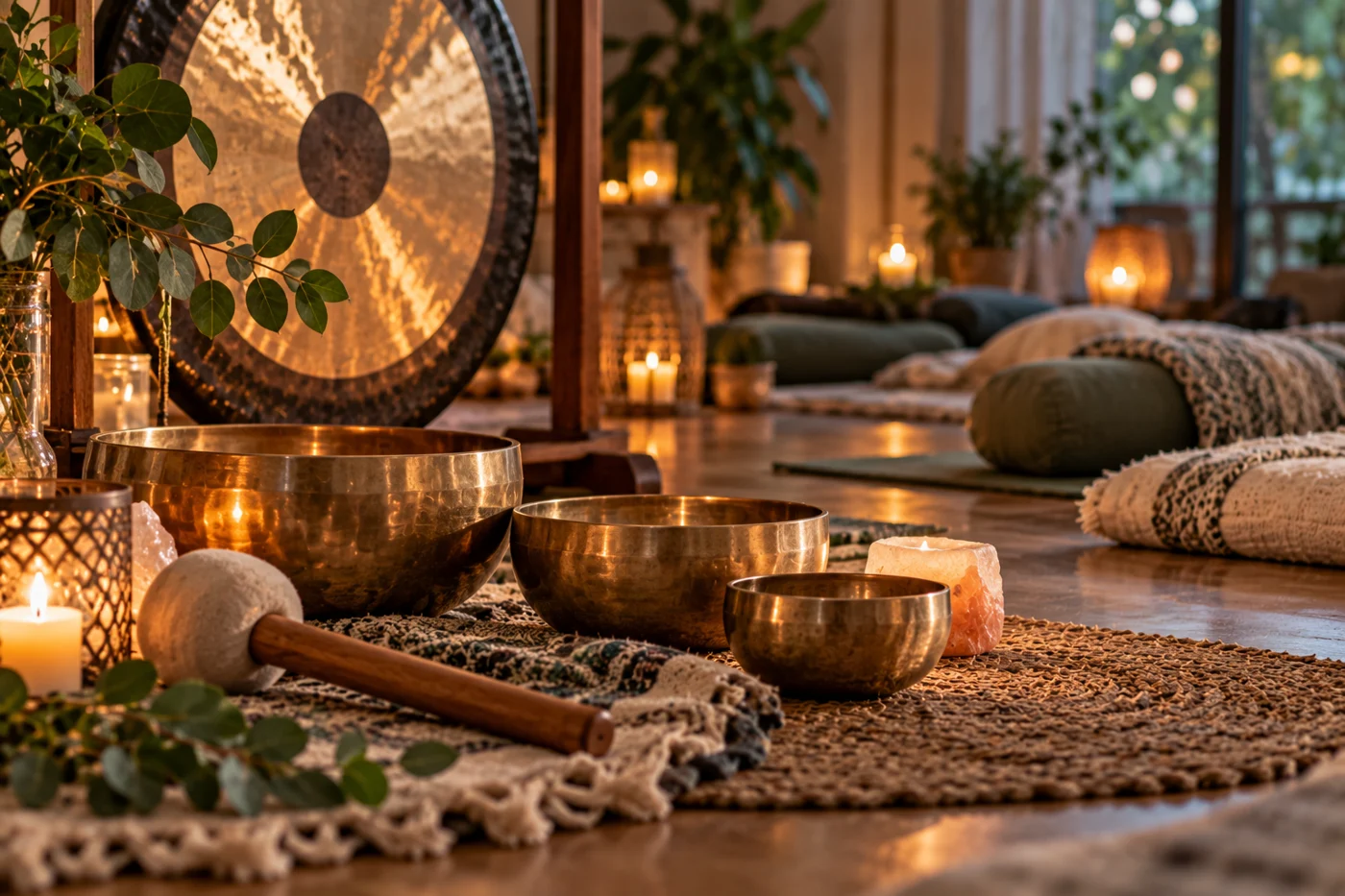
There is something undeniably different about being in a room filled with sound.
A singing bowl begins to resonate. A gong produces a tone you can almost feel rather than simply hear. Layers of sound build and fade while everyone in the room is doing something we do surprisingly little of in everyday life: lying still and listening.
Sound baths, singing bowls, gongs, tuning forks, chanting, music meditation, and other sound-based practices have become increasingly common in wellness spaces. Along with them have come some much bigger claims—that certain frequencies can “reset” the nervous system, release stored trauma, balance energy centers, improve cellular function, or even heal particular organs.
Some of those claims travel much farther than the research does.
But that does not mean sound is doing nothing. Human beings respond to sound in remarkably complex ways, and researchers are actively studying how music and other sound-based interventions interact with the brain, stress, emotion, pain, movement, and relaxation. The
National Institutes of Health even supports a Sound Health research initiative focused on understanding how music-based interventions affect the brain and health. NCCIH
The interesting part, to me, is figuring out where the science ends and the experience begins.
What Do We Mean by “Sound Healing”?
The term sound healing does not describe one standardized practice.
Someone using that phrase might be referring to a group sound bath with crystal or metal singing bowls, a gong meditation, tuning forks, drumming, chanting, music used during meditation, or a practitioner creating different sounds around or near the body.
That makes studying “sound healing” difficult because these experiences are not necessarily interchangeable. The sound, volume, duration, setting, instruments, practitioner, expectations, breathing patterns, and whether someone is lying down or actively participating can all differ.
There is also an important distinction between sound wellness practices and music therapy.
Music therapy is an established health profession in which a trained music therapist uses music within a therapeutic relationship to address specific physical, emotional, cognitive, or social needs. Simply attending a sound bath or listening to relaxing music is not the same thing as receiving music therapy from a credentialed professional. NCCIH
Both experiences can still be meaningful. They just should not be treated as if they carry the same evidence or clinical purpose.
Why Can Sound Feel So Powerful?
Hearing is not an isolated sense.
Sound is processed through networks in the brain involved in emotion, attention, memory, movement, and sensation. Music can influence arousal, evoke memories almost instantly, change our perception of an environment, and alter how we experience time. NIH notes that listening to and making music activates multiple brain regions involved in thinking, sensation, movement, and emotion. NCCIH
There is also context.
Imagine walking into a dim room, putting your phone away, lying on a comfortable mat, closing your eyes, and knowing that no one expects anything from you for the next forty-five minutes.
Then add slow, sustained sound.
Even before we determine whether a particular bowl frequency has a unique biological effect, we have created an environment that is dramatically different from answering emails, driving through traffic, listening to children argue, or scrolling through a phone. 😂
That environment alone may change how someone feels.
And that does not make the experience somehow less legitimate.
Singing Bowls Have Actually Been Studied
Singing bowls are probably one of the better-known sound-healing tools, and the research base is beginning to grow.
A 2025 systematic review evaluated 14 quantitative studies involving Tibetan singing-bowl interventions in adults. Most reported improvements in outcomes such as anxiety, depressive symptoms, well-being, quality of life, heart rate, heart-rate variability, or brainwave activity.
However, the authors also emphasized substantial differences among the studies, including varying protocols and relatively limited sample sizes. PubMed
Another recent systematic review examined 19 clinical studies of singing bowls, including randomized trials and other study designs. The overall literature suggested possible benefits for anxiety, depressive symptoms, sleep, and some physiological outcomes, but the researchers found so much variation among studies that even some anxiety data could not appropriately be combined into one meta-analysis. PubMed Central (PMC)
In other words, there is a signal worth investigating.
We just do not yet have a perfectly standardized, enormous body of evidence telling us exactly who benefits, from what type of bowl, at what frequency, for how long.
What Happens During a Single Sound-Bowl Session?
One small randomized controlled trial gives us an interesting glimpse.
Researchers studied 50 adults with elevated state anxiety and compared one Tibetan singing-bowl session with progressive muscle relaxation and a waiting-list control. Both the singing-bowl and muscle-relaxation groups reported decreased anxiety compared with the control group. The singing-bowl group also showed changes in heart-rate variability and EEG measurements consistent with an acute relaxation response. PubMed Central (PMC)
That is interesting.
But I would not turn that into “singing bowls permanently regulate your nervous system.”
The study examined what happened around one session. Acute relaxation is valuable, but it is different from proving that an intervention treats an anxiety disorder or permanently changes autonomic function.
That distinction matters enormously in wellness.
What About Stress?
The broader research on music-based interventions is considerably larger than the research specifically on sound baths.
NCCIH summarizes evidence from more than 100 studies suggesting music-based interventions can produce small-to-moderate improvements in physiological measures related to stress and larger improvements in some psychological measures such as anxiety, nervousness, and feelings of worry. Music therapy delivered by trained professionals may have somewhat stronger effects in certain situations because the intervention can be individualized. NCCIH
This gives us a much more reasonable statement than “sound heals stress.”
Sound and music can influence how people experience stress, and structured music-based interventions have demonstrated measurable effects in research.
That is already fascinating.
We do not need to turn it into something mystical to make it valuable.
Can You Really “Feel” Sound in Your Body?
Absolutely.
Sound is vibration. When a sound wave travels through air and reaches us, it creates mechanical movement that our auditory system detects and converts into neural signals.
Certain low-frequency sounds can also be physically perceptible. If you have ever stood near a large speaker at a concert and felt the bass in your chest, you already know this.
Singing bowls create both audible tones and mechanical vibrations. Researchers are beginning to explore whether vibration itself contributes to some reported effects, although much of that mechanistic research remains early or preclinical. A recent animal study, for example, investigated the vibration component of singing bowls separately from sound—but findings in animals cannot automatically be translated into human therapeutic claims. PubMed Central (PMC)
So yes, vibration is real.
What we should be careful about is the leap from “you can physically perceive vibration” to “this vibration is healing individual cells or organs.”
Those are very different statements.
What About 432 Hz, 528 Hz, and “Healing Frequencies”?
This may be the part of sound wellness that requires the most caution.
You will find entire charts online assigning specific frequencies to particular emotions, organs, chakras, DNA repair, trauma release, or cellular healing. Sometimes those claims are presented with an enormous amount of scientific-sounding language.
There is currently not strong clinical evidence demonstrating that listening to a specific frequency such as 432 Hz or 528 Hz selectively heals an organ, repairs DNA, clears trauma, or produces the broad health effects frequently claimed online.
That does not mean a person cannot prefer music tuned a particular way. A specific tone may feel calming, pleasant, unpleasant, stimulating, or deeply relaxing depending on the individual.
Preference itself can matter.
But enjoying a frequency and proving a unique medical effect from that exact number are two different things.
I think we can allow sound to feel meaningful without needing every Hertz value to become a prescription.
Sound and the Nervous System
You will also hear sound baths described as a way to “regulate” or “reset” the nervous system.
There is some reason for the interest. Studies have measured outcomes such as heart rate, heart-rate variability, anxiety, EEG activity, and other physiological responses during or after sound-based interventions. The 2025 singing-bowl review found several studies reporting changes in measures related to autonomic function. PubMed
But our nervous system is enormously complex.
It is not an electrical breaker that gets flipped into the wrong position and needs a gong to reset it.
A sound practice may help someone slow down. Their breathing may change. Muscle tension may decrease. Attention may shift away from stressful thoughts. They may experience a temporary reduction in perceived anxiety.
Those effects can all be valuable.
I would rather describe them accurately than promise that a forty-five-minute sound bath has permanently “regulated” someone's nervous system.
Can Sound Release Trauma?
This is another phrase I would handle carefully.
People may absolutely experience emotion during sound practices. Music and sound can trigger powerful memories, tears, relaxation, discomfort, grief, joy, or sensations that seem to appear unexpectedly.
Music is closely connected to memory and emotion, and NCCIH specifically notes that certain sounds or music can provoke strong emotional responses and may even be distressing for some people. NCCIH
But experiencing an emotional release is not the same as clinically treating trauma.
Trauma-related disorders can involve complex psychological and physiological responses, and sound baths should not be presented as replacements for trauma-focused mental-health treatment.
We will get into this much more when we do our trauma-informed wellness article, because I think wellness spaces need to become much more thoughtful about casually promising to “release trauma.”
Sound can be part of someone's supportive environment.
That is different from claiming it resolves the trauma itself.
Why Some People May Not Find a Sound Bath Relaxing
This is important because wellness often assumes everyone will respond to the same calming practice the same way.
Some people love singing bowls.
Someone else may hear a gong and immediately want to leave the room. 😂
Certain tones may feel physically uncomfortable. Repetitive sounds can be distressing for people with some sensory sensitivities. Loud sound can aggravate tinnitus or headaches for some individuals. And because sound and music can trigger memories and emotions, a practice intended to feel relaxing can occasionally have the opposite effect.
NCCIH also points out the most obvious physical safety concern: sound that is too loud can contribute to noise-induced hearing loss. NCCIH
A supportive practitioner should never tell someone that discomfort means the sound is “clearing something” and therefore they need to endure it.
You are allowed to dislike the gong.
A Sound Bath Can Still Be Valuable Without Being Medical Treatment
I think this is where sound healing becomes much easier to understand.
Maybe you attend a sound bath and feel deeply relaxed afterward.
Great.
Maybe the sustained tones make meditation easier because your brain has something to focus on.
Great.
Maybe lying quietly with your eyes closed for an hour gives you a rare opportunity to stop thinking about the next thing on your list.
Also great.
None of those experiences need to be upgraded into a medical claim before they count.
We sometimes make wellness unnecessarily complicated by believing that a practice must cause some dramatic cellular transformation before it is worth our time.
Feeling calmer for an hour can be useful.
Enjoying yourself can be useful.
Having a ritual that encourages you to slow down can be useful.
Sound Healing and Music Therapy Should Not Be Confused
Because this article uses the word healing, I think this distinction deserves repeating.
A sound bath practitioner and a music therapist are not interchangeable roles.
Music therapy involves specific professional training and the therapeutic use of music within a clinical relationship. Depending on the setting, a music therapist may work with rehabilitation, emotional health, communication, cognition, movement, pain, or other individualized goals. NCCIH
A sound bath is generally a wellness or meditative experience. That does not make one “real” and the other meaningless. It simply tells us what kind of service we are actually participating in.
Language matters.
Where Sound Healing Fits for Me
I think sound fits beautifully into the mind-body wellness category when we allow it to stay grounded.
It can provide another way to meditate for people who struggle with silent meditation. It can create a strong sensory cue that it is time to slow down. It can become part of breathing, relaxation, yoga, or restorative practices. Some people may simply enjoy the experience of resonant sound moving through a quiet room.
Research gives us legitimate reasons to continue exploring its effects on anxiety, stress, emotion, and physiological relaxation.
The evidence does not require us to claim that a bowl is detoxifying cells, aligning organs, repairing DNA, or clearing stored trauma.
Sometimes the less dramatic explanation is still pretty amazing.
Human beings respond to sound.
We always have.
Observe
Think about the sounds that surround you during an ordinary day.
Traffic.
Television.
Notifications.
Machinery.
Music.
Kids.
Conversations.
Appliances.
Podcasts.
Silence, if you are lucky enough to find some.
Then notice what different sounds actually do to you.
Which ones make your shoulders tighten?
Which ones make it easier to concentrate?
Which music instantly changes your mood?
Which sounds make your home feel calmer?
And what happens when you intentionally choose sound rather than simply absorbing whatever noise happens to surround you?
Maybe you eventually try a sound bath.
Maybe singing bowls are not your thing and you discover that listening to music with the lights down does the same job beautifully.
The goal is not to find the frequency somebody online says your body needs.
It is to become a little more aware of how your own body responds to sound.
A Note About Sound-Based Wellness Practices
Sound baths and similar practices are intended for general wellness and relaxation and should not be used as substitutes for appropriate medical or mental-health care. Sound can sometimes evoke strong emotions or memories, and excessive volume can damage hearing. People with sound sensitivities, tinnitus, migraines, certain neurological conditions, or other concerns may want to discuss participation with an appropriate healthcare professional or practitioner and should feel free to leave or modify a session that feels uncomfortable.
References
Lin F-W, Yang Y-H, Wang J-Y. Effects of Tibetan Singing Bowl Intervention on Psychological and Physiological Health in Adults: A Systematic Review. 2025. Included 14 quantitative studies and found promising results for anxiety, mood, well-being and several physiological measures while identifying important limitations in the evidence. PubMed
Therapeutic effects of singing bowls: A systematic review of clinical studies. Reviews randomized and nonrandomized clinical studies involving singing bowls and highlights both promising outcomes and substantial heterogeneity among studies. PubMed Central (PMC)
Goldsby TL, et al. Effects of Singing Bowl Sound Meditation on Mood, Tension, and Well-being: An Observational Study. Participants reported lower tension, anxiety and several negative mood states after a sound meditation, although the study lacked a randomized control group. PubMed Central (PMC)
Acute Relaxation Response Induced by Tibetan Singing Bowl Sounds: A Randomized Controlled Trial. Compared singing bowls with progressive muscle relaxation and a waiting-list control and found reductions in self-reported anxiety along with changes in HRV and EEG measures. PubMed Central (PMC)
National Center for Complementary and Integrative Health. Music and Health: What You Need To Know. Summarizes research involving music-based interventions for stress, pain, anxiety, sleep and other outcomes and distinguishes music therapy from other music-based practices.