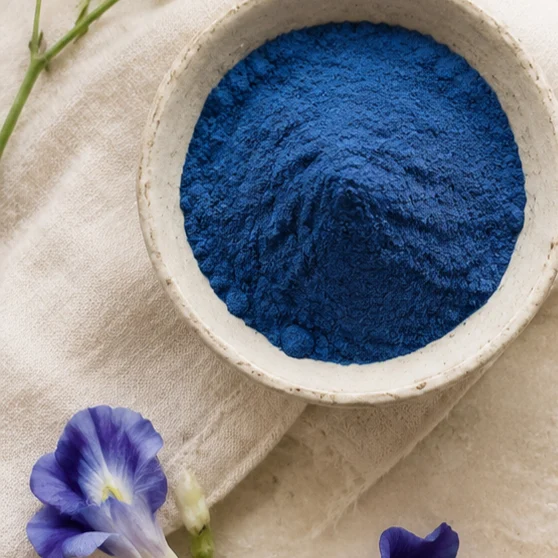
The first thing anyone notices about cocoBLUE is obviously the color. Mix it into water and you get a bright blue drink that looks almost too colorful to have come from foods. But that color is only the beginning of what makes the formula interesting.
The current cocoBLUE blend combines blue spirulina, butterfly pea flower, moringa, whole-food vitamin ingredients, coconut water, chlorella, amla, several sea vegetables, pumpkin-derived magnesium, bamboo-derived silica, and black pepper. The Supplement Facts panel also gives us something more useful than a marketing description: actual nutrient amounts.
A two-scoop serving provides 5 grams of the cocoBLUE blend, 90 mg of vitamin C, approximately the full Daily Value of several B vitamins, 414 mcg DFE of folate, 150 mcg of iodine, 39 mg of magnesium, 2 mg of iron, 102 mg of potassium, and 38 mg of silica. The current label lists no additional ingredients.
That is a pretty unusual nutritional profile for a five-gram powder, but there is one limitation we need to establish before looking at the individual ingredients. cocoBLUE is a proprietary blend.
We know the entire blend weighs 5,000 mg, but we do not know the exact amounts of spirulina, chlorella, amla, moringa, butterfly pea, or the individual sea vegetables.
That matters because a clinical study using several grams of one ingredient cannot automatically be applied to a product containing an undisclosed amount of that same ingredient. So rather than turning every PubMed study into a cocoBLUE claim, I want to use the research for what it actually tells us: why these ingredients are interesting in the first place.
Why Is It So Blue?
The first ingredient is blue spirulina, listed as Arthrospira platensis that has been cold-water extracted. Spirulina is technically a cyanobacterium rather than a traditional plant or seaweed, and its vivid blue color comes largely from phycocyanin, a pigment-protein that has been studied for antioxidant and inflammatory activity.
Spirulina itself has a meaningful amount of human research behind it. A 2025 systematic review and meta-analysis of randomized controlled trials found modest reductions in systolic and diastolic blood pressure with spirulina supplementation. Another recent meta-analysis involving dozens of randomized trials found improvements across several cardiometabolic measurements, including blood lipids, fasting glucose, blood pressure, and some inflammatory markers.
That does not mean cocoBLUE has been shown to produce those effects. Spirulina studies often use gram-level amounts of spirulina itself, while cocoBLUE contains five grams of its entire multi-ingredient blend. We simply do not know whether the spirulina portion reaches the same amounts used in those trials.
Still, the blue ingredient brings much more to the formula than a pretty color.
Butterfly Pea Brings Another Kind of Blue
The formula also contains butterfly pea flower, or Clitoria ternatea. Its intense blue-purple color comes from plant pigments in the anthocyanin family, the same broader family of compounds responsible for many of the colors in blueberries, blackberries, cherries, and purple vegetables.
Human research on butterfly pea is still relatively small, but it has moved beyond laboratory-only research. In one randomized crossover trial involving healthy adults, butterfly pea extract consumed alongside sucrose was associated with lower post-meal glucose and insulin responses and changes in measures of antioxidant capacity. Another small study looked at butterfly pea with a high-fat meal and found changes in several post-meal metabolic and antioxidant measures.
These studies were small and used specific doses of butterfly pea extract, so they should not be treated as proof that the amount in cocoBLUE produces the same response. What they do show is that butterfly pea is not simply being added for visual appeal. Its plant pigments are biologically active enough to be studied in humans.
Chlorella Has More Research Behind It Than I Expected
Chlorella is a green microalga and is biologically different from spirulina, even though the two often get placed in the same “greens powder” category. The cocoBLUE label specifically lists broken-cell-wall Chlorella vulgaris, which is relevant because the cell wall can influence how readily the contents of chlorella become available during digestion.
A recent systematic review and dose-response meta-analysis included 24 studies and found small average improvements in several measurements, including LDL cholesterol, total cholesterol, insulin resistance, inflammatory markers, body weight, and body-fat percentage.
An earlier meta-analysis also reported modest reductions in total and LDL cholesterol.
One thing I found particularly interesting in the chlorella research was how often product quality came up. In an earlier review, only a small number of the included trials clearly documented things such as purity, potency, and contamination testing of the chlorella products being used.
That brings us right back to a principle that applies to almost every ingredient we talk about here: the ingredient name is only part of the story. Source, processing, and testing matter too.
Amla Deserves a Real Place in This Formula
The actual cocoBLUE label confirms that amla is included, appearing as Orgen-C® organic amla extract from Phyllanthus emblica.
Amla, sometimes called Indian gooseberry, contains vitamin C, polyphenols, and many other naturally occurring plant compounds. Unlike some wellness ingredients that are promoted mostly on traditional use or cell studies, amla has also been studied in randomized human trials.
A 2023 systematic review and meta-analysis found improvements in several metabolic measurements, including total cholesterol, LDL cholesterol, triglycerides, fasting glucose, and C-reactive protein, along with an increase in HDL cholesterol. The researchers still noted variation between the trials and the need for larger, better-standardized studies.
Again, that tells us something about amla, not necessarily about the amount of amla contained in cocoBLUE.
But having human randomized-trial evidence makes amla one of the more interesting ingredients in the formula, especially because the finished product also gives us a standardized amount of vitamin C.
Moringa: Nutritious Without Needing the Hype
Moringa leaf has a much larger wellness reputation than the current human evidence really supports. The leaves contain polyphenols, carotenoids, vitamins, minerals, protein, and numerous other plant compounds, which makes moringa nutritionally interesting even before we start talking about disease outcomes.
A 2025 meta-analysis of randomized controlled trials looked at moringa supplementation for cardiometabolic outcomes and found that results were much less dramatic than many online claims suggest. Most measurements did not show consistent significant improvement, and the overall certainty of evidence was low.
I actually like including research like that because it reminds us that a food can be worth eating without having to act like medicine. Moringa can contribute nutrients and plant compounds without needing to cure blood sugar problems, inflammation, cholesterol issues, or everything else that gets attached to it online.
Nutritious is already useful.
The Marine Ingredients Make cocoBLUE Very Different From a Typical Greens Powder
The formula includes chlorella along with several sea vegetables: laver, sea lettuce, dulse, and an Icelandic triple-kelp blend containing Laminaria hyperborea, Ascophyllum nodosum, and Laminaria digitata.
These foods bring a different nutrient profile than land vegetables. Depending on the species, sea vegetables can contain iodine, magnesium, potassium, iron, fiber, proteins, carotenoids, polyphenols, and unique marine polysaccharides. Human research on edible algae has grown enough that recent meta-analyses now include dozens of randomized trials.
One recent analysis involving 29 randomized trials and more than 1,500 adults found small reductions in systolic and diastolic blood pressure from edible algae interventions overall, although there was considerable variation between individual studies and spirulina appeared to account for some of the stronger effects.
That is encouraging, but marine foods also raise an important safety issue because they can concentrate substances from their environment. That includes desirable minerals, but potentially also contaminants. Species, growing conditions, processing, and finished-product testing therefore matter quite a bit.
The Iodine Amount Is Actually Known
One advantage of having the actual Supplement Facts panel is that we do not have to guess how much iodine cocoBLUE provides.
A full serving contains 150 mcg of iodine, listed as 100% of the Daily Value, supplied by the kelp blend, laver, dulse, and sea lettuce.
Iodine is essential for normal thyroid hormone production, but it is also a nutrient where more is not automatically better. Seaweeds can contain dramatically different amounts of iodine depending on the species, growing location, processing method, and serving size, and excessive iodine intake can affect thyroid function in susceptible people.
Because cocoBLUE provides a standardized 150 mcg per serving, it is easier to evaluate than simply eating an unknown quantity of kelp. But it also means cocoBLUE should be counted as an iodine source, particularly for someone who already takes iodine separately, regularly eats seaweed, or has a thyroid condition.
That is not a reason to fear the marine ingredients. It is simply a reason to know what is actually in the scoop.
The Vitamin C Is More Than a Trace Amount
The finished formula contains 90 mg of vitamin C per serving, or 100% of the Daily Value. The label attributes its whole-food vitamin C primarily to the amla-based Orgen-C® ingredient.
That detail matters because it means we are not simply saying, “Amla contains vitamin C.” We know the finished product itself provides a standardized amount.
The same principle applies to several of the B vitamins.
The B Vitamins Are More Substantial Than I Expected
The current label lists approximately the full Daily Value of thiamin, riboflavin, niacin, pantothenic acid, vitamin B6, biotin, and folate. The Orgen-B’s® ingredient is sourced from guava, holy basil, and lemon.
Folate is especially notable. One serving provides 414 mcg DFE, or 104% of the Daily Value, and the label states that it comes from whole-plant sources including amla, with naturally occurring 5-MTHF and folate cofactors rather than added folic acid.
That does not mean a plant-derived vitamin is automatically superior to every conventional supplemental form. Absorption and utilization depend on the nutrient, chemical form, food matrix, digestion, dose, and individual nutritional status.
But it does mean these are not simply trace amounts buried in a long ingredient list.
B12 is the exception. The formula contains only 0.13 mcg, or 6% of the Daily Value, from marine foods such as laver, chlorella, dulse, and sea lettuce. I would not look at cocoBLUE as someone's primary B12 source.
Magnesium, Iron, Potassium, and Silica
The mineral portion is another place where the label gives us much better information than general phrases like “mineral rich.”
A serving supplies 39 mg of magnesium, 2 mg of iron, and 102 mg of potassium. Magnesium comes from several plant and marine sources, including organic pumpkin extract, moringa, coconut water, laver, sea lettuce, chlorella, dulse, and kelp.
Those are meaningful contributions, but they are not massive doses. Magnesium provides about 9% of the Daily Value, iron around 12%, and potassium around 2%.
The label also lists 38 mg of silica, with bamboo extract included as Orgen-Si®. Silica is found naturally in foods and connective tissues and continues to be studied in relation to areas such as bone, skin, hair, and connective-tissue biology, although claims in those areas depend heavily on the particular form and dose being studied.
This is exactly why I prefer actual numbers over phrases like “packed with minerals.” Some nutrients are present at or near the full Daily Value, while others are present in smaller supportive amounts.
Both can be true.
Coconut Water Fits Without Needing to Be Magical
Coconut water powder contributes naturally occurring minerals and is especially well known as a source of potassium. It makes sense in a formula built around whole-food nutrient sources, but I would not turn that into a claim that cocoBLUE is automatically a superior hydration product.
Human studies comparing coconut water with plain water or standard electrolyte beverages after exercise have generally not shown a clear, consistent hydration advantage.
That does not make coconut water useless. It simply places it in a more realistic role: another nutrient-containing food ingredient contributing to the overall formula.
And Then There Is Black Pepper
The final ingredient listed is whole black pepper fruit.
Black pepper contains piperine, a compound that has been studied because it can influence intestinal absorption, transport proteins, and enzymes involved in drug metabolism. This is where the common supplement phrase “black pepper improves bioavailability” comes from.
That phrase can be too simplistic, though. Piperine's ability to alter absorption is also why concentrated piperine extracts can interact with some medications.
cocoBLUE lists whole black pepper fruit rather than a specified concentrated piperine extract, and the amount is not disclosed. Because of that, I would not assume the black pepper dramatically increases absorption of every nutrient in the formula.
It is better viewed as another ingredient with interesting biological properties rather than a universal absorption switch.
Five Grams Still Puts Everything in Perspective
This may be the most important section of the entire article.
One serving contains 5 grams total, and that five grams has to include blue spirulina, butterfly pea, moringa, the Orgen-B ingredient, coconut water, pumpkin extract, chlorella, laver, amla, bamboo extract, three kelps, sea lettuce, dulse, and black pepper.
That means we cannot take a clinical trial that used several grams of spirulina, another trial using a specific dose of amla extract, and another study using a concentrated butterfly pea extract and assume one scoop of cocoBLUE reproduces every one of those interventions.
Ingredient research helps us understand why the ingredients were selected.
It does not automatically establish the effect of the finished blend.
The nutrients actually quantified on the label—such as vitamin C, iodine, folate, magnesium, iron, potassium, and silica—give us stronger information about what a serving definitely provides.
That distinction makes the product more understandable, not less interesting.
What I Actually Like About cocoBLUE
The more closely I look at this formula, the less interested I become in describing it with complicated phrases like “cellular activation.”
Its strongest feature may actually be much simpler.
cocoBLUE combines a surprisingly diverse group of foods that most people do not eat regularly. Spirulina, chlorella, moringa, amla, butterfly pea, laver, sea lettuce, dulse, several species of kelp, guava, holy basil, lemon, pumpkin, and bamboo are not exactly the average
Tuesday grocery list. 😂
It also provides standardized amounts of several nutrients rather than relying entirely on the vague promise of “trace vitamins and minerals.” The current label shows 100% DV vitamin C, approximately 100% of several B vitamins, 104% DV folate, 100% DV iodine, plus smaller contributions of magnesium, iron, potassium, B12, and silica.
And according to the current label, there are no other ingredients.
That combination—nutritional variety plus a relatively straightforward ingredient panel—is what makes it interesting to me.
If you want to see the formula I currently use and recommend, you can find cocoBLUE on my
Products I Recommend page.
What I Would Not Claim
I would not say cocoBLUE detoxifies the body, repairs damaged cells, switches on mitochondria, balances hormones, corrects every mineral deficiency, boosts immunity, or reproduces all the clinical outcomes found in research on its individual ingredients.
We simply do not have finished-product clinical trials establishing those outcomes.
But I also would not dismiss it as “just another greens powder.” Several of its ingredients have legitimate human research behind them, its marine ingredients contribute a different nutritional profile from most plant powders, and the finished label provides concrete quantities for several vitamins and minerals.
That is already enough to make it worth understanding.
We do not need to add miracle claims on top.
Where cocoBLUE Fits in Foundational Wellness
No powder replaces a varied diet. Vegetables, fruit, protein, fiber, healthy fats, adequate hydration, and enough total food still form the nutritional foundation.
But real life does not always look like a perfectly photographed farmer's-market basket either.
A whole-food powder can be a convenient way to introduce foods and plant compounds that someone may rarely consume otherwise. That is where I think cocoBLUE fits best: beside the foundation rather than instead of it.
It can add variety. It cannot make the basics optional.
Observe
If you are comparing a whole-food powder, look past the number of superfoods printed on the front and turn the container around.
Look at the serving size, the actual vitamin and mineral amounts, whether individual ingredient quantities are disclosed, and whether the label contains other ingredients that were not obvious from the marketing. Then look at the research and ask whether the ingredient was studied in humans, what form was used, and whether the dose in the study resembles anything you might realistically be getting from the finished product.
That does not take the fun out of wellness.
It helps us understand what we are actually buying and why we are using it.
cocoBLUE has a genuinely interesting ingredient list. It does not need to promise everything to earn a place in the conversation.
Sometimes the formula is interesting enough without turning it into a miracle.
A Note About cocoBLUE
cocoBLUE contains 150 mcg of iodine per serving from kelp, laver, dulse, and sea lettuce. People with thyroid conditions, those taking thyroid medication, people using additional iodine supplements, and those who are pregnant or breastfeeding should discuss their total iodine intake with an appropriately qualified healthcare professional. Black pepper contains compounds that may influence drug metabolism at certain doses, although the amount present in cocoBLUE is not individually disclosed. This article is for general wellness education and is not medical advice.
References
Spirulina: 2025 systematic review and meta-analysis of randomized controlled trials examining blood-pressure outcomes. PMID: 39529406.
Spirulina cardiometabolic research: Recent meta-analysis of randomized trials examining blood lipids, glucose, blood pressure, and inflammatory markers. PMID: 40953712.
Chlorella: Systematic review and dose-response meta-analysis examining metabolic and inflammatory outcomes. PMID: 42420253.
Chlorella and lipids: Systematic review and meta-analysis of randomized controlled trials. PMID: 35331862.
Amla: Systematic review and meta-analysis of randomized trials examining lipid profile, glucose, and C-reactive protein. PMID: 36934568.
Moringa: 2025 meta-analysis of randomized controlled trials examining cardiometabolic outcomes. PMID: 41305552.
Butterfly pea: Randomized crossover trial examining post-meal glucose, insulin, and antioxidant measures. PMID: 29310631.
Edible algae: Systematic review and meta-analysis of 29 randomized trials involving 1,583 adults. PMID: 40726022.
Seaweed and iodine: 2024 review examining excessive iodine intake from seaweed and thyroid implications. PMID: 39379288.
Coconut water and hydration: Systematic review of oral rehydration beverages following exercise-associated dehydration. PMID: 38116818.
Black pepper/piperine: Review of piperine's effects on absorption, transport proteins, drug metabolism, and potential interactions. PMID: 29250980.